Solid top
Standard riser
The most asked-for size: 15 in wide, a solid top.
- Inside width
- 15″
- Leg height
- 4″
- Depth
- 9″
- Corner radius
- 0.25″
All values
Perforation Ø: 0″
Perf. pitch: 0.625″
Perf. margin: 1″
Staggered: yes
Model LM-R04 · 4 common sizes
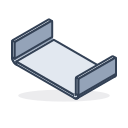
Custom-bent monitor riser: optional perforated top, two independent legs, height and depth sized to your desk.
Price without signing up · Made in Quebec · $49 minimum order
A preset fills in the model; you then change each dimension in the application.
Solid top
The most asked-for size: 15 in wide, a solid top.
Perforation Ø: 0″
Perf. pitch: 0.625″
Perf. margin: 1″
Staggered: yes
A smaller size for a small screen or a tight desk.
Perforation Ø: 0″
Perf. pitch: 0.625″
Perf. margin: 1″
Staggered: yes
Perforated top
A large size with a staggered perforated top, visually lighter.
Perforation Ø: 0.25″
Perf. pitch: 0.75″
Perf. margin: 1″
Staggered: yes
A large monitor
Taller legs to clear more storage underneath.
Perforation Ø: 0″
Perf. pitch: 0.625″
Perf. margin: 1″
Staggered: no
Bending is built into the model. The rest is added in the application, with the same instant price.
Bending
Bend lines placed at the dimensions you set.
Tapping
Threads to suit material and thickness
PEM hardware
Nuts, studs, standoffs
Powder coating
Hard surface, UV stable
Anodizing
Aluminum, several colors
The shop’s notes for this model.
A bridge: a top the screen stands on, carried by two legs. Two same-direction bends, the same principle as an upside-down U channel, to free up desk space underneath the screen or bring it to the right height.
The inside width is measured between the two legs — the clear space left underneath, not the part's overall width.
It is not decoration. A solid top in thin sheet visibly sags under a screen, and removing metal from the middle does not help — the perforation exists so the buyer can see that the top is a sheet-metal part and pick a thickness accordingly, not to lighten the part. Perforations can be staggered, and a margin protects the top's edge and the bend zone.
The model refuses a top whose open area exceeds 35% of its surface: past that point the top stops behaving like a stiff panel.
Load is not guaranteed by this model: nothing here says how much screen the top can carry. It is the thickness and material you choose, not the geometry, that hold the screen up.
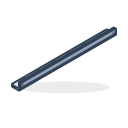
Cable comb with paired zip-tie slots, flat or bent into an L to screw to a wall or floor.
See the model →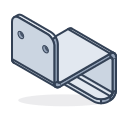
Three-bend headphone hanger shaped like a hook, with a generous cradle radius and a custom-drilled mounting plate.
See the model →
Custom-bent vertical laptop stand: width set from device thickness plus clearance, optional pad slots for anti-slip feet.
See the model →Not quite it? Start from a basic shape or upload your drawing (DXF, DWG, SVG, AI, EPS) or your 3D model (STEP).
Configure one part or a series. See your price and lead time before ordering.
No account needed for pricing · Free shipping from $49