Stainless Steel 304
The most versatile stainless: #2B mill finish, #4 brushed for visible surfaces, #1 for thick plate.
304 stainless is the reference austenitic grade for general corrosion resistance, clean appearance, and reliable formability. In sheet form, it bends, forms, and welds easily while work hardening during forming. In annealed condition it is non-magnetic (slight magnetism may appear after cold deformation).
- Thicknesses12 thicknesses, from 24 ga (0.025 in) to 1/2 in
- ProcessFiber laser cutting, ±0.005 to ±0.012 in tolerance
- OperationsBending, stamped collar (dimple), laser engraving, hardware insertion, powder coating, printed graphic
- Max. size30 × 44 in per part, from one part
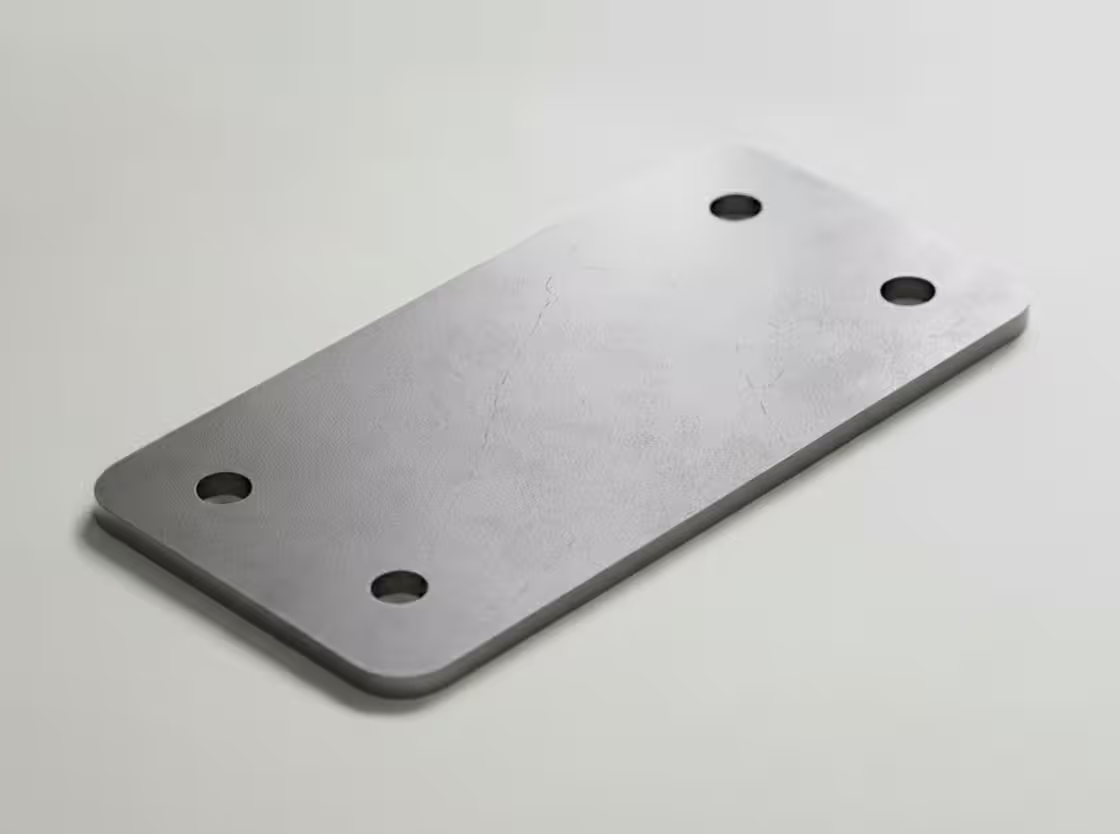
It resists rust in most indoor environments and many outdoor settings, including washing and food service areas. Laseo offers it in three surface finishes: #4 brushed (24 to 11 gauge) for visible surfaces, #2B rolled (20 gauge to 3/16″) for industrial use, and #1 (1/4″ to 1/2″) for structural plate. Ideal for panels and enclosures, food/pharmaceutical equipment, architectural hardware, guards, tanks, flanges, and durable, easy-to-clean components.
Composition and Properties
Cr-Ni austenitic alloy (≈18% Cr, 8% Ni) balancing corrosion, formability, and weldability; surface hardness superior to aluminum for sharp edges with appropriate tooling.
Corrosion Behavior
Performs well in atmospheric, fresh water, and mild chemical environments; tolerates regular washing in food service.
In chloride-rich environments (coastal spray, de-icing brines, bleach), risk of pitting/crevice corrosion increases; 316 is generally preferred for severe exposures.
After fabrication, passivation restores/thickens the protective oxide.
Forming and Mechanics
Good bending and moderate stamping; work hardens rapidly—plan for appropriate radii and progressive forming for deep shapes.
Springback higher than carbon steel—account for this in bend developments.
Magnetism: Non-magnetic when annealed; may become slightly magnetic after rolling/bending.
Welding and Assembly
MIG/TIG/resistance welding common. Heat-affected zones may be slightly less corrosion resistant; 304L is often chosen to limit sensitization during heavy welding.
Galling possible between stainless threaded surfaces—use compatible anti-seize and reasonable speeds; consider dissimilar or coated hardware.
Isolate from carbon steels to avoid contamination/contact rust.
Understanding the finishes: #1, #2B, and #4
#1: hot rolled, annealed, and pickled—a matte, rough surface reserved for heavy thicknesses (1/4″ to 1/2″) where function matters more than appearance.
#2B: cold rolled, the standard "mill" finish—a smooth, pearl-gray, slightly reflective surface. The best value for industrial parts, offered from 20 gauge to 3/16″.
#4 brushed: polished with a directional satin grain—the classic "commercial kitchen" look. It's the choice for any visible surface: panels, cladding, decorative plates. Offered from 24 to 11 gauge; in the very thin gauges (24-22), it's in fact the only finish available.
For a uniform appearance on an assembly, group parts from the same batch/finish. On #4, orient the grain in the same direction on all visible parts.
Thicknesses and Typical Uses
0.025"–0.060" (≈0.6–1.5 mm): Panels, light cladding, appliance covers, architectural facings.
0.063"–0.125" (≈1.6–3.2 mm): Enclosures, flanges, machine guards, sink components, food equipment.
0.188"–0.312" (≈4.8–8.0 mm): Structural plates, heavy flanges, tank heads/ends, wear surfaces.
0.375"–0.500" (≈9.5–12.7 mm): Bases, frames, clamping plates, and high-rigidity assemblies.
Cutting and Machining
Fiber laser cutting with sharp edges and thermal management. Tapping is not offered on stainless—for threads, plan for self-clinching hardware insertion (PEM nuts).
Typical 2D cutting tolerance: ±0.005"; small tabs may hold parts for optimal precision.
Common Applications
Food and beverage equipment, architectural hardware and facings, handrails, chemical/pharmaceutical equipment, machine panels and guards, tanks and lids, flanges, supports, and components requiring cleanliness and everyday rust resistance.
In Brief
304 combines attractive appearance, good corrosion resistance, and broad fabrication versatility across a wide thickness range—a reliable choice for industrial and architectural parts meant to last.
Get this material cut to your specs
Upload your drawing or use the sketch generator: pick the material, thickness and operations, and get your price on the spot.
Thicknesses and specifications — 304 Stainless Steel - #2B, #4 or #1 finish
Overview of available thicknesses and manufacturing capabilities for this material. The tabs above give full details per thickness.
View the thicknesses and tolerances table
| Thickness | Gauge | Cutting tolerance | Process | Bending (effective inside radius) |
|---|---|---|---|---|
| 0.025" | 24 gauge | ±0.005" | Fiber laser | — |
| 0.0312" | 22 Gauge | ±0.005" | Fiber laser | Yes (0.085") |
| 0.0375" | 20 Gauge | ±0.005" | Fiber laser | — |
| 0.050" | 18 Gauge | ±0.005" | Fiber laser | Yes (0.094") |
| 0.0625" | 16 Gauge | ±0.005" | Fiber laser | Yes (0.141") |
| 0.0781" | 14 gauge | ±0.005" | Fiber laser | Yes (0.117") |
| 0.1094" | 12 Gauge | ±0.005" | Fiber laser | Yes (0.203") |
| 0.1250" | 11 Gauge | ±0.005" | Fiber laser | Yes (0.188") |
| 0.1875" | 7 Gauge | ±0.005" | Fiber laser | Yes (0.250") |
| 0.250" | 1/4" | ±0.005" | Fiber laser | Yes (0.346") |
| 0.375" | 3/8" | ±0.008" | Fiber laser | — |
| 0.500" | 1/2" | ±0.012" | Fiber laser | — |
Available operations and finishes
This material is bendable (0.0312", 0.050", 0.0625", 0.0781", 0.1094", 0.1250", 0.1875", 0.250"). Radii, K-factors and design rules in the bending guide.