Hardware Insertion (PEM)
Hardware Insertion (PEM)
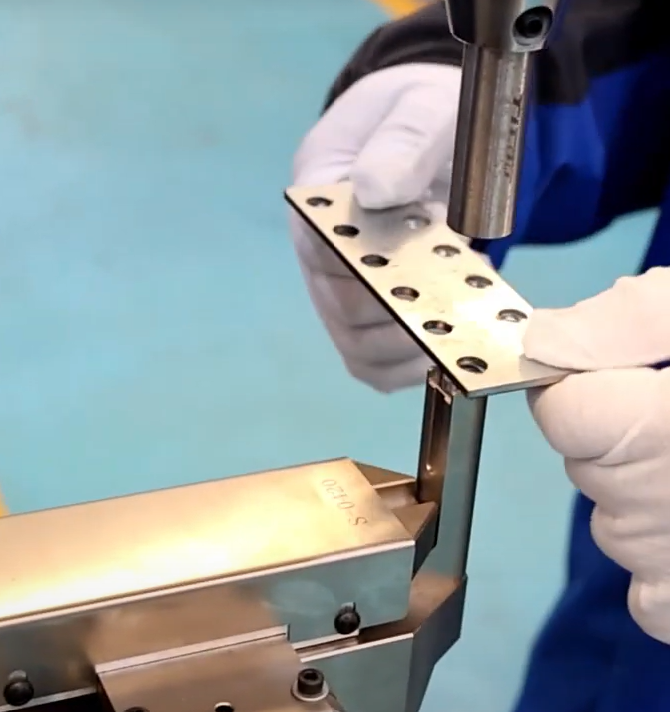
Hardware insertion integrates PEM® self-clinching fasteners — threaded studs, standoffs, and nuts — directly into sheet metal to create load-bearing threads without tapping or welding. A precision press drives the knurled collar into a laser-cut hole, causing cold flow of surrounding metal for permanent retention and flush surfaces on both sides. For a reliable bond, each insert is matched to the sheet thickness range (grip range), edge clearances, material hardness, then oriented perfectly perpendicular to the part. The application automatically filters compatible PEM sizes according to alloy, thickness and required spacing, ensuring clean installation and assemblies that fit right the first time.
General requirements managed by app: automatic hole resizing, edge clearance verification, minimum spacing between identical and different hardware, and distance to bend zones.
See the geometry and surface detail

Photorealistic illustration. Appearance varies with the material, finish and lighting.
What is it for?
PEM inserts add a strong, permanent thread to a sheet-metal part without having to weld or screw on a separate piece. In practice, they let you assemble, disassemble and reassemble your parts with standard fasteners — self-clinching nuts, threaded studs and standoffs — while keeping flush surfaces on both sides.
Inserts are installed before bending, while the sheet is still flat: the press has clear access and the insert ends up perfectly perpendicular to the surface. That's why you need to plan enough distance between the insert and the bend zones right from the design stage.
This service is offered on aluminum, mild steel, galvanized steel and stainless steel (304 and 316).
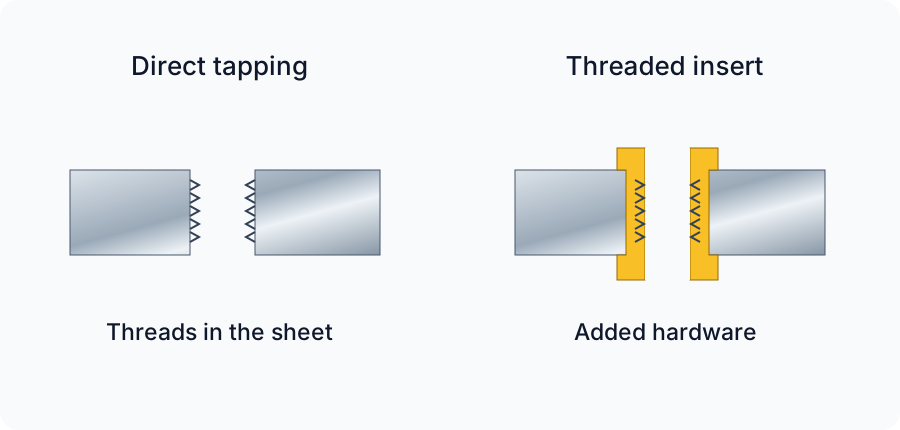
The alternative to tapping
On thin sheet, there simply isn't enough material to form a reliable thread: tapping can strip out under tightening torque. A PEM insert spreads the load over its full footprint and provides a load-bearing thread where tapping wouldn't hold.
It's also the solution we use for 304 and 316 stainless steel: we don't offer tapping on stainless — its hardness and tendency to gall make the operation unreliable. Stainless PEM inserts give strong, clean threads on those parts.
Typical use cases
Electronics enclosures and cabinets, access panels, removable chassis and brackets, assemblies with repeated fastening — anywhere you want a strong, reusable attachment point on sheet metal. Browse the PEM hardware catalog to choose your references.
Compatible Materials
Discover materials supporting PEM hardware insertion in our production flow.
Technical Specifications
What you need to know about hardware
- Slight tooling marks possible around installed inserts.
- Installation after anodizing or other plating treatments. For powder coating, threads are masked to stay clean.
- Mild steel, aluminum and galvanized steel delivered with zinc-plated PEM; stainless parts delivered with stainless PEM hardware.
- Part size constraints (general): min 1" × 1.5", max 36" × 46".
- We automatically resize mounting hole to catalog dimension; check minimum edge clearances, bend zones and hardware-to-hardware spacing.
- Selectable holes (up to 4.00") are sized for chosen PEM reference; if a size is unavailable, it's often due to conflict with adjacent edge or cut.
- Respect sufficient distance to bend zones; no insertion on parts with sharp bends.
- Common types supported: self-clinching nuts, standoffs and flush-head threaded studs.
- Consult the complete PEM catalog for detailed specifications.
Complete PEM Hardware Catalog
Consult our detailed catalog of 128 insert hardware references: self-tapping nuts, threaded studs and standoffs. PEM datasheets available for each product.
Your part, your choices, your price.
Configure one part or a series. See your price and lead time before ordering.
No account needed for pricing · Free shipping from $49