Find a guide
Workshop, tooling and organization

Model LM-H06 · 4 common sizes

Drill jig made to size

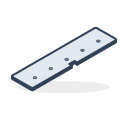
Drill jig with a registration notch: transfers a repeatable hole pattern onto the work, registered on a real edge instead of a pencil mark.

Drill jig: model illustration
  • Aluminum 5052-H32 8G
  • Instant price
  • Free shipping from $49

Price without signing up · Made in Quebec · $49 minimum order

Start from a common size

A preset fills in the model; you then change each dimension in the application.

Most popular

5 holes

Standard jig

The most asked-for size: a row of 5 holes and a registration notch.

Length
8″
Width
2″
Corner radius
0.125″
Hole Ø
0.25″
All values

Hole count: 5
1st hole: 1″
Hole pitch: 1.5″
Row to edge: 0.75″
Row 2 to edge: 0″
Row 2 offset: 0.75″
Notch width: 0.5″
Notch depth: 0.25″
Configure

Two staggered rows

A second, offset row: transfers two drilling patterns at once.

Length
8″
Width
2″
Corner radius
0.125″
Hole Ø
0.25″
All values

Hole count: 5
1st hole: 1″
Hole pitch: 1.5″
Row to edge: 0.5″
Row 2 to edge: 1.5″
Row 2 offset: 0.75″
Notch width: 0.5″
Notch depth: 0.25″

Configure

No registration notch

A plain jig, no notch: positioned by eye or with another reference.

Length
8″
Width
2″
Corner radius
0.125″
Hole Ø
0.25″
All values

Hole count: 5
1st hole: 1″
Hole pitch: 1.5″
Row to edge: 0.75″
Row 2 to edge: 0″
Row 2 offset: 0.75″
Notch width: 0″
Notch depth: 0.25″

Configure

Long jig

A row of holes stretched over a longer length.

Length
16″
Width
2″
Corner radius
0.125″
Hole Ø
0.25″
All values

Hole count: 8
1st hole: 1″
Hole pitch: 2″
Row to edge: 0.75″
Row 2 to edge: 0″
Row 2 offset: 0.75″
Notch width: 0.5″
Notch depth: 0.25″

Configure

Operations and finishes

They are added in the application, with the same instant price.

Choosing your dimensions

The shop’s notes for this model.

What it is for

A drill jig transfers a hole pattern onto real work, repeatably, without measuring it out again every time. It is a plate pierced with the pattern you need, held against the work and lined up with a registration notch on one edge - that notch is what makes it a jig rather than a simple template: without a positive reference, the pattern is only as good as the pencil mark that positioned it.

The rows of holes are dimensioned the same way every other model in the catalogue dimensions a row: the first hole is measured from the reference edge, then the rest follow a fixed pitch - never from an edge of the plate, because a jig whose holes moved with the plate size would transfer the wrong pattern, which is worse than no jig at all.

A second row, offset along the jig, is available for a two-row pattern.

What the model refuses, and why

  • A length or width of zero. A part with no dimension does not exist.
  • A row of holes that does not fit the jig's length, or sits too close to an edge of the width. Reduce the pitch, the hole count or the position of the first one; a row set too far off-centre runs off the jig.
  • A registration notch that does not fit. Too deep, it cuts the jig in two; too wide for the available length, it runs into the rounded corners.

Same family

See all 2

Not quite it? Start from a basic shape or upload your drawing (DXF, DWG, SVG, AI, EPS) or your 3D model (STEP).

Your part, your choices, your price.

Configure one part or a series. See your price and lead time before ordering.

Get my instant price →

No account needed for pricing · Free shipping from $49