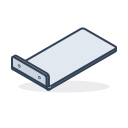
Standard tent card
The most asked-for size: a solid face, a 65° lean.
- Face height
- 4″
- Foot length
- 2.5″
- Width
- 6″
- Lean angle
- 65°
All values
Corner radius: 0.1875″
Window width: 0″
Window height: 3.5″
Window radius: 0.125″
Model LM-S01 · 4 common sizes
Custom-leaning counter tent card holder, with an optional window for a printed card and a foot sized so it will not tip.

Price without signing up · Made in Quebec · $49 minimum order
A preset fills in the model; you then change each dimension in the application.
The most asked-for size: a solid face, a 65° lean.
Corner radius: 0.1875″
Window width: 0″
Window height: 3.5″
Window radius: 0.125″
A cut window so a printed card inserted from behind shows through.
Corner radius: 0.1875″
Window width: 4″
Window height: 3.5″
Window radius: 0.125″
Nearly upright: hardly any foot needed.
Corner radius: 0.1875″
Window width: 0″
Window height: 3″
Window radius: 0.125″
A pronounced lean: a longer foot to stay stable.
Corner radius: 0.1875″
Window width: 0″
Window height: 3.5″
Window radius: 0.125″
Bending is built into the model. The rest is added in the application, with the same instant price.
Bending
Bend lines placed at the dimensions you set.
Tapping
Threads to suit material and thickness
PEM hardware
Nuts, studs, standoffs
Powder coating
Hard surface, UV stable
Anodizing
Aluminum, several colors
The shop’s notes for this model.
A display that leans back: a face where a message reads or a printed card slides in, and a bent foot that holds it standing, tilted backward. One bend, but at a real angle — 90 degrees is exactly the wrong default for a tent card, which has to lean or it falls flat.
An optional window cut into the face lets a card inserted from behind show through, instead of engraving the text into the metal: the content can then change without remaking the part.
The face and the foot are dimensioned OUTSIDE the bend. Leaning backward, the face overhangs its own bend line by a distance equal to its height times the cosine of the lean angle: that is the tipping arm, the point past which the centre of gravity falls outside the footprint. The model refuses a foot shorter than that arm — the part would tip forward the moment it is set down.
The usable angle range runs from 30 to 90 degrees: close to 90, the card stands nearly upright and needs a very long foot to stay up; the lower the angle, the more the card leans and the shorter a foot can be. An open bend also tends to spring back and close slightly after the press releases it — one more reason to pick the angle with some margin rather than to the degree.
Not quite it? Start from a basic shape or upload your drawing (DXF, DWG, SVG, AI, EPS) or your 3D model (STEP).
Configure one part or a series. See your price and lead time before ordering.
No account needed for pricing · Free shipping from $49